MLP G1 Characters: Original My Little Pony Cast & Names
Searching for MLP G1 characters can lead to two different answers: the original toy ponies collectors identify by body, hair, symbol, and release year, or the animated characters who appeared in the 1980s specials and series. This guide keeps those layers together without treating every G1 pony as one universal cartoon cast.
Quick Answer: Who Are the MLP G1 Characters?
MLP G1 characters are the original My Little Pony characters connected with the first generation, usually the 1982–1992 U.S. toy era and its international releases, plus the animated specials, film, and television projects that accompanied it. The first six collector ponies were Blossom, Blue Belle, Butterscotch, Cotton Candy, Minty, and Snuzzle. Later G1 groups added Pegasus, Unicorn, Flutter, Sea, Baby, Big Brother, Rainbow, So Soft, and many other pony types.
The important boundary is that G1 is not a single “Mane 6” cast. The toy line, Rescue at Midnight Castle, My Little Pony 'n Friends, and My Little Pony Tales each emphasize different characters. If you want the modern Twilight Sparkle, Applejack, Rainbow Dash, Pinkie Pie, Rarity, and Fluttershy, use the site's MLP Characters guide instead.
What Does G1 Mean in My Little Pony?
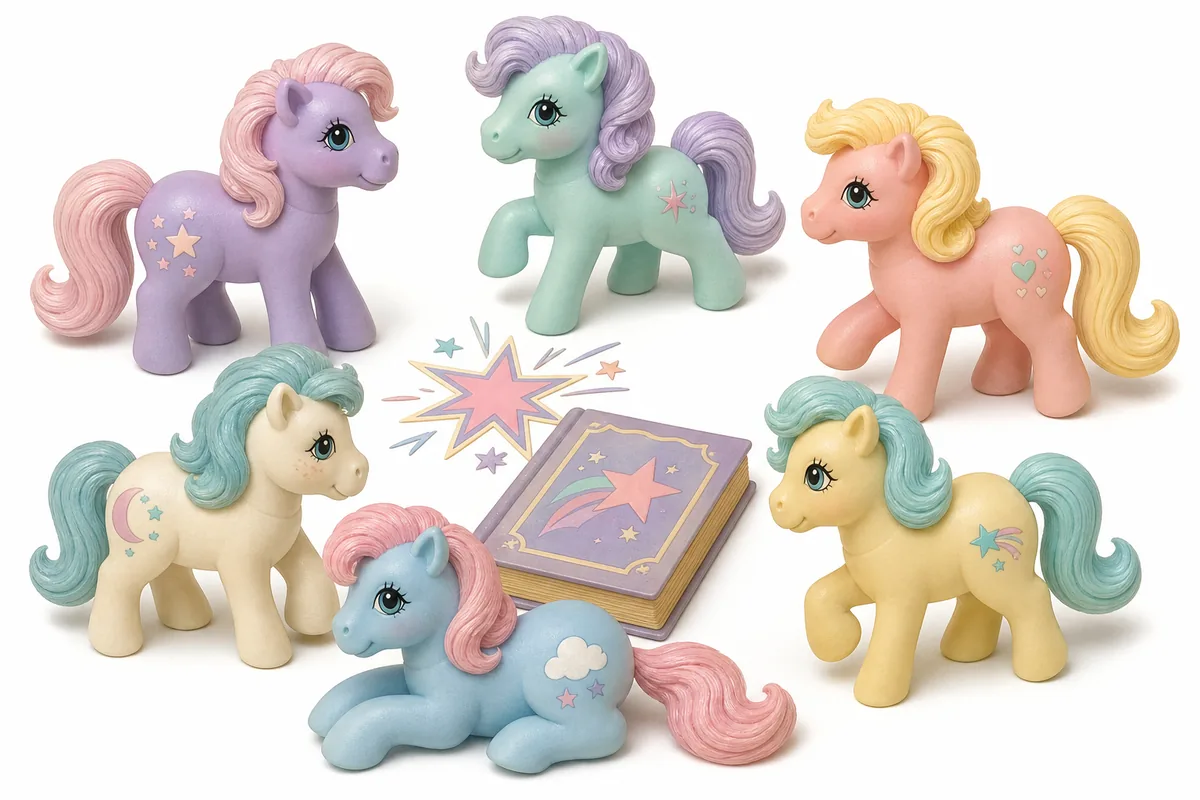
“G1” is collector and fan shorthand for the original My Little Pony generation. The first My Little Pony toy line launched in 1982 after My Pretty Pony, and the U.S. line ran through 1992, with international releases continuing later. The label is useful because it lets a reader separate the early rounded pony designs from the slimmer G2 line, the colorful G3 revival, the Friendship Is Magic G4 era, and the newer G5 world.
G1 is therefore a family of releases, not just one cartoon. A collector may be asking about a Year 2 Earth Pony, a Rainbow Pony, a European variant, or a mail-order release. A fan of the animated material may instead mean Megan, Firefly, Applejack, Twilight, or the cast of My Little Pony 'n Friends. Those are related questions, but they need different answers.
The large public catalogues of G1 ponies are organized by country, body color, year, pony type, and product group. That structure is a clue to the search intent: a useful MLP G1 character list should help readers identify a figure, understand its group, and avoid mixing a toy name with a later animated interpretation.
The First Six My Little Pony G1 Characters
The safest starting point for an original My Little Pony characters search is the first collector group. These six ponies are frequently treated as the beginning of the G1 story, and later anniversary reproductions also use them as the reference set. Their names are more stable than their exact appearance: country versions, hair changes, factory differences, and reissues can alter the details.
| Character | Why the name matters | Best identification habit |
|---|---|---|
| Blossom | One of the original six collector ponies and a recurring early-generation name. | Compare the body color, flower-style flank symbol, hair, and country variant. |
| Blue Belle | A first-wave name that is easy to confuse with later blue ponies when the photo is incomplete. | Use the symbol and the exact pose, not color alone. |
| Butterscotch | Part of the first collector trio and one of the names preserved in retro reissues. | Check mane shade, flank design, hooves, and whether the pony is a later reproduction. |
| Cotton Candy | A first-generation name that also appears in early animation and later baby-pony naming. | Separate the adult toy, baby version, and animated usage before comparing details. |
| Minty | A first-wave name associated with the early pastel palette and later nostalgic reissues. | Record the body and hair color together; either one alone is too broad. |
| Snuzzle | The sixth name in the original collector set and a frequent reference point for G1 lists. | Compare the flank symbol, face, mane, and release country with a catalogue entry. |
These six are a starting point, not the complete G1 cast. The line quickly expanded into different pony types and themed groups, which is why a page that only lists the first six will not satisfy readers searching for all MLP G1 characters.
The Original Animated MLP G1 Cast
G1 animation introduced a story layer that the toy checklist cannot fully capture. The 1984 specials, the 1986 film, and the 1986–1987 television material used a group of recurring ponies alongside human character Megan and the dragon Spike. The exact lineup shifts by production, so “the G1 cast” should be treated as a group of related screen characters rather than one fixed team.
| Character or group | Where readers may encounter the name | How to keep the boundary clear |
|---|---|---|
| Megan | The human-world bridge in early animated stories. | She is not a pony, but she is central to the way the earliest stories frame Dream Valley. |
| Firefly | Early animation and one of the best-known G1 Pegasus names. | Do not automatically treat her as Rainbow Dash; later generations rework ideas and names. |
| Applejack | A G1 Earth Pony name that later became a major G4 character. | Check the generation before using G4 personality, family, or cutie-mark details. |
| Bow Tie and Cotton Candy | Early animated stories and the original toy character pool. | Screen appearances can give a name a stronger personality than the toy packaging does. |
| Twilight, Medley, Posey, Gusty, and others | Specials, the film, and the broader early animated ensemble. | Use the production title or episode when a name is shared by more than one generation. |
| My Little Pony Tales cast | The 1992 series arrived at the end of the original-generation period. | Characters such as Starlight, Sweetheart, Melody, Bright Eyes, Patch, Clover, and Bon Bon form a separate late-G1 screen group. |
If your main question is “which G1 pony appeared in the cartoon?”, start with the production title, then check the character name. That one extra step prevents the most common mistake: taking a modern G4 profile and applying it to a G1 toy or an early screen version.
G1 Pony Groups and Character Types
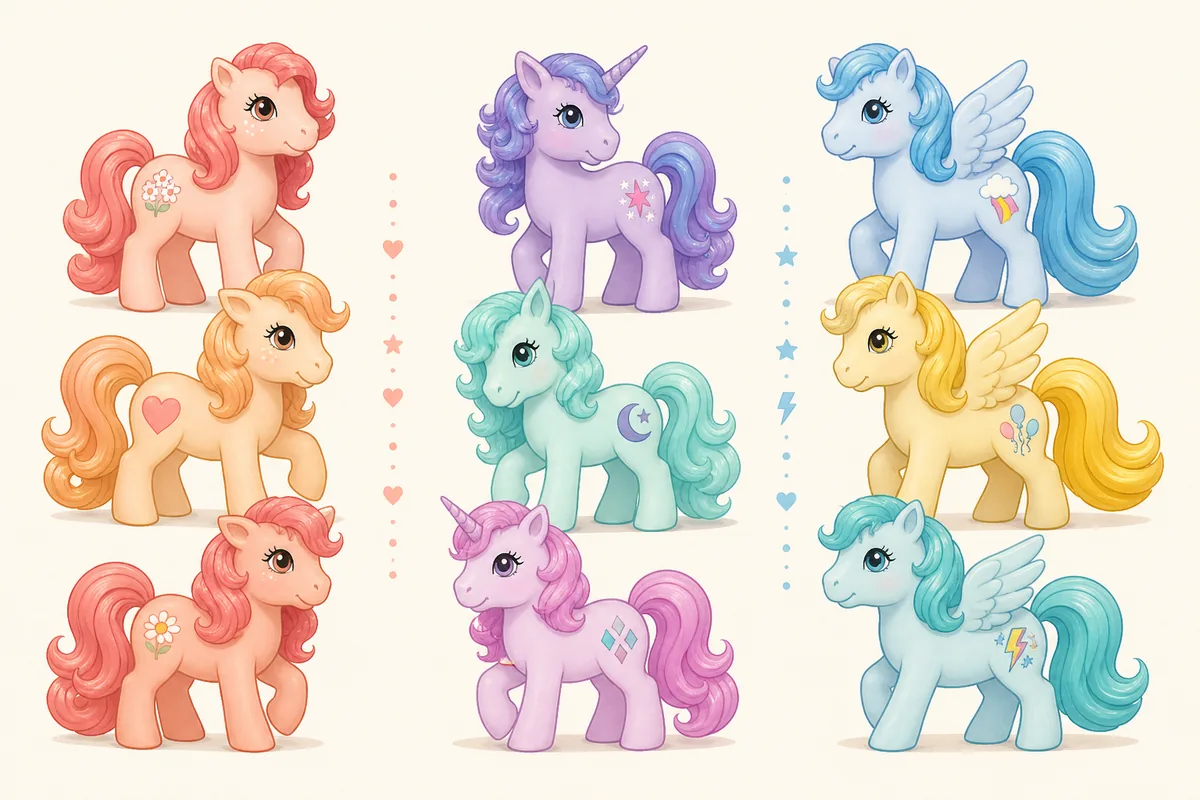
A flat alphabetical list is hard to use because G1 characters were released in recognizable groups. The group often tells you more than a first glance at the body color: wings, a flocked texture, rhinestone eyes, a sea-pony tail, a baby scale, or a special symbol can narrow the search quickly.
| G1 group | What makes it different | Examples of the search question |
|---|---|---|
| Earth Ponies | Four-legged pony body without a horn or wings; often the easiest baseline for comparison. | “Which orange G1 pony is this?” or “Is this an early Applejack release?” |
| Unicorn and Pegasus Ponies | A horn or wings changes the identification path, but hair and symbol details still matter. | “Is this Firefly, Gusty, Glory, or another winged/unicorn release?” |
| Rainbow and themed Ponies | Distinct hair, glitter, scent, symbols, or color concepts can make a group recognizable. | “Is this a Rainbow Pony, Twinkle-Eyed Pony, or a later variant?” |
| Baby, Big Brother, and Sweetheart Sister Ponies | Size, body proportions, hooves, and family packaging provide strong clues. | “Is this a baby version of an adult name?” or “Is this a Big Brother release?” |
| Sea and Flutter Ponies | Tail shape or smaller wing design can separate them from standard land ponies. | “Is this a Sea Pony, Flutter Pony, or a winged accessory variant?” |
| International and mail-order variants | Body, hair, eye, symbol, pose, and packaging details may differ by country or release route. | “Why does this G1 pony look different from the U.S. catalogue photo?” |
For a broad era comparison, continue with the site's My Little Pony generations guide. It explains where G1 fits beside G2, G3, G4, and G5; this page goes deeper into the names and identification problems inside G1 itself.
How to Identify an MLP G1 Pony
When a reader has a loose pony without packaging, the best approach is a short evidence trail rather than a guess based on color. Use these steps in order:
- Record the country or source. A U.S. release, an international variant, a mail-order pony, and a later reproduction may share a name but not every physical detail.
- Describe the body type. Note Earth, Unicorn, Pegasus, Flutter, Sea, Baby, Big Brother, or another recognizable group.
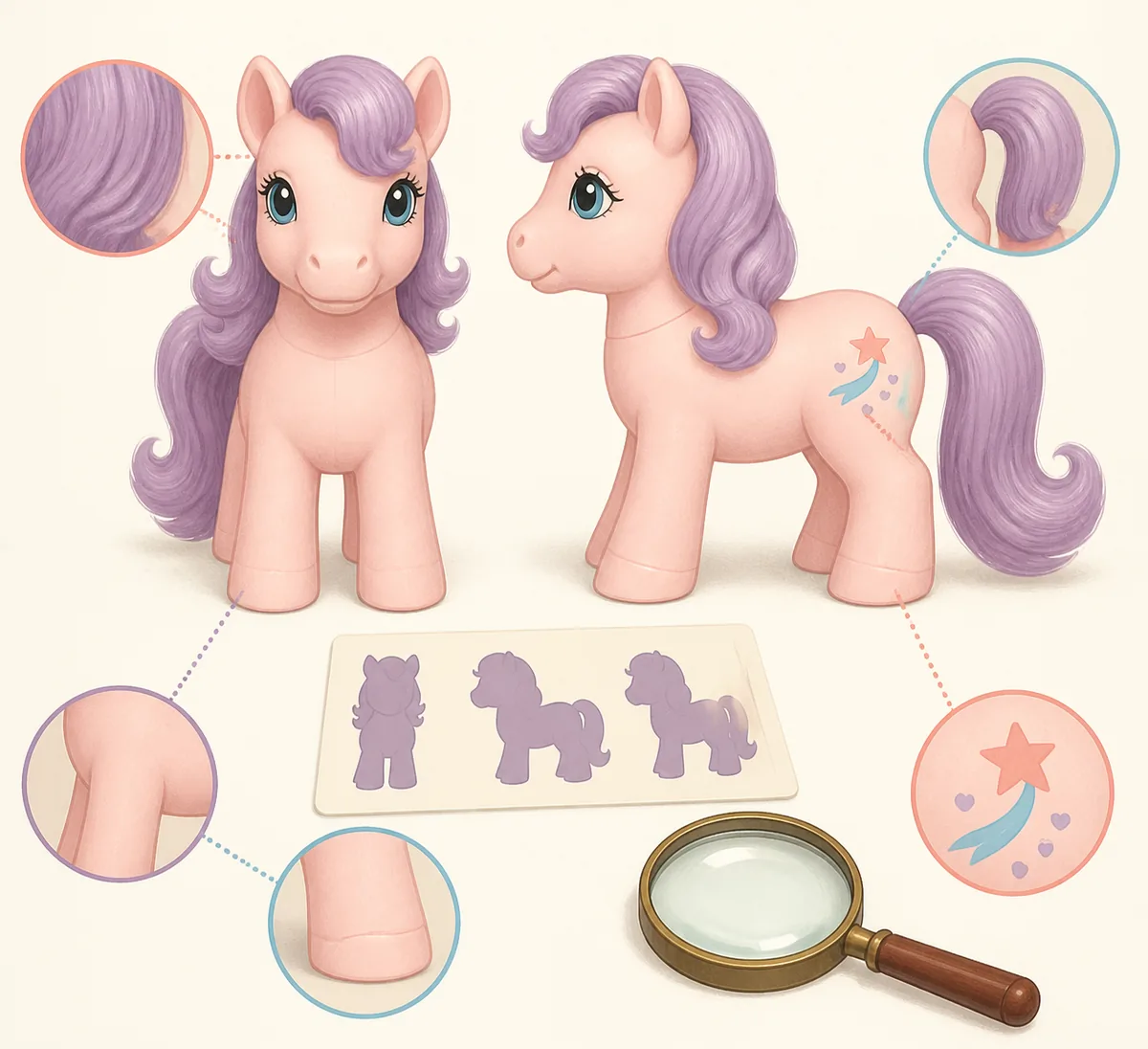
- Photograph the hair and forelock. Color, length, curl, fading, and the presence or absence of a forelock are often more useful than the body color alone.
- Check the flank symbol closely. Use the shape, number of marks, glitter, paint, and placement. A symbol is a clue, not a substitute for a full comparison.
- Inspect hooves and factory details. Country marks, mold differences, hoof hair, and body texture can separate a common release from a variant.
- Compare against a reference catalogue. Search by the combined description—body type + color + symbol + group—rather than typing only “pink G1 pony.”
Strawberry Reef's G1 references are useful because they organize entries by country, body color, release year, and pony type. Its own disclaimer also makes the right use clear: treat the catalogue as a collector aid and ask permission before reusing its contributed images. This page uses that identification logic while keeping its local visuals original and non-official.
MLP G1 Characters vs G4 Characters
Searchers often land on the wrong page because a name appears in more than one generation. Applejack is the clearest example, but the same issue applies to Twilight, Firefly-inspired ideas, and many symbols. A shared name is a useful bridge for discovery, not proof that the character has the same backstory.
| Question | G1 answer | G4 answer |
|---|---|---|
| What is the character system? | A broad toy-and-media ecosystem with many product groups and changing screen casts. | A story-led ensemble centered on the Mane 6, Ponyville, and the Elements of Harmony. |
| How are characters identified? | Body, hair, flank symbol, pony type, country, year, and package or playset context. | Personality, relationships, story role, cutie mark, and recurring show continuity. |
| What should a reader search next? | “MLP G1 characters,” “G1 my little pony,” or a physical description. | “Which MLP character are you,” “Mane 6 personality,” or a named G4 character. |
For personality matching rather than vintage identification, try the MLP personality types guide or the Pony Personality page. For original-pony naming and symbols, the My Little Pony names guide and Cutie Mark Test are better matches than a G1 catalogue.
Bottom Line
The best MLP G1 characters guide separates three layers: the original toy names, the early animated cast, and the many collector groups and international variants. Start with the first six—Blossom, Blue Belle, Butterscotch, Cotton Candy, Minty, and Snuzzle—then use body type, hair, symbol, country, and release context to narrow the rest. When a name also appears in G4, check the generation before importing a modern personality or story.
FAQ: MLP G1 Characters
What are MLP G1 characters?
They are the original My Little Pony toy and animation characters associated with the first generation, commonly dated from the 1982 line through the early 1990s. The exact cast changes depending on whether you mean toys, specials, the 1986 series, or My Little Pony Tales.
Who were the first six My Little Pony characters?
The first six collector ponies are Blossom, Blue Belle, Butterscotch, Cotton Candy, Minty, and Snuzzle. Country releases, later variants, and reproductions can change the appearance details used to identify one individual pony.
Are G1 and G4 My Little Pony characters the same?
Usually not. The generations can reuse names, colors, symbols, or broad ideas, but they belong to different toy and story systems. A shared name does not automatically mean the same continuity or personality.
Who is the main MLP G1 character?
There is no single G1 equivalent of the G4 Mane 6 across every product and screen release. Megan is a key human bridge in early animation, while Firefly, Applejack, Cotton Candy, Bow Tie, Twilight, and other ponies receive different levels of focus across productions.
How do I identify an MLP G1 pony?
Record the country or release context, pony type, body and hair colors, forelock, flank symbol, hoof details, pose, and any package or playset clue. Compare the combined evidence with a collector reference instead of relying on color alone.
Is My Little Pony Tales part of G1?
It is commonly discussed as a late-G1 or adjacent early-1990s screen project because it appeared at the end of the original-generation period. Its cast is different from the 1986 animated group, so keep the series title in your search.
Sources and Related Reading
For brand history and the broad G1 timeline, see the official My Little Pony site and the National Toy Hall of Fame / Museum of Play overview. For collector-level names, country variants, body colors, and pony groups, use Strawberry Reef's U.S. G1 index and its G1 country-variant reference. For an overview of early animated characters, the 1986 character list is a secondary cross-check, not an official cast bible.