My Little Pony Generations Explained: G1, G2, G3, G4 & G5
My Little Pony generations are the shorthand fans use to separate major changes in the toy lines, character designs, stories, and screen worlds. The simplest map is G1 through G5, but the useful part is knowing what each label helps you find—and where the boundaries become fuzzy.
Quick Answer: What Are the My Little Pony Generations?
In common fan and collector language, G1 means the original 1980s-to-1990s era, G2 the shorter transition period, G3 the bright pony-focused revival of the 2000s, G4 the Friendship Is Magic era that began in 2010, and G5 the newer A New Generation screen and toy identity. Release dates overlap by country and product line, so the table below uses approximate eras rather than pretending that one calendar year changed everything overnight.
If you only want a starting point, choose G4 for the best-known character and story gateway, G1 for vintage history and collecting, G3 for colorful direct-to-video nostalgia, or G5 for the newer cinematic and contemporary setting. Searches for MLP generations or generations of My Little Pony usually mean this same era-by-era map. Read the MLP Characters guide when your main question is who the characters are rather than how the generations differ.
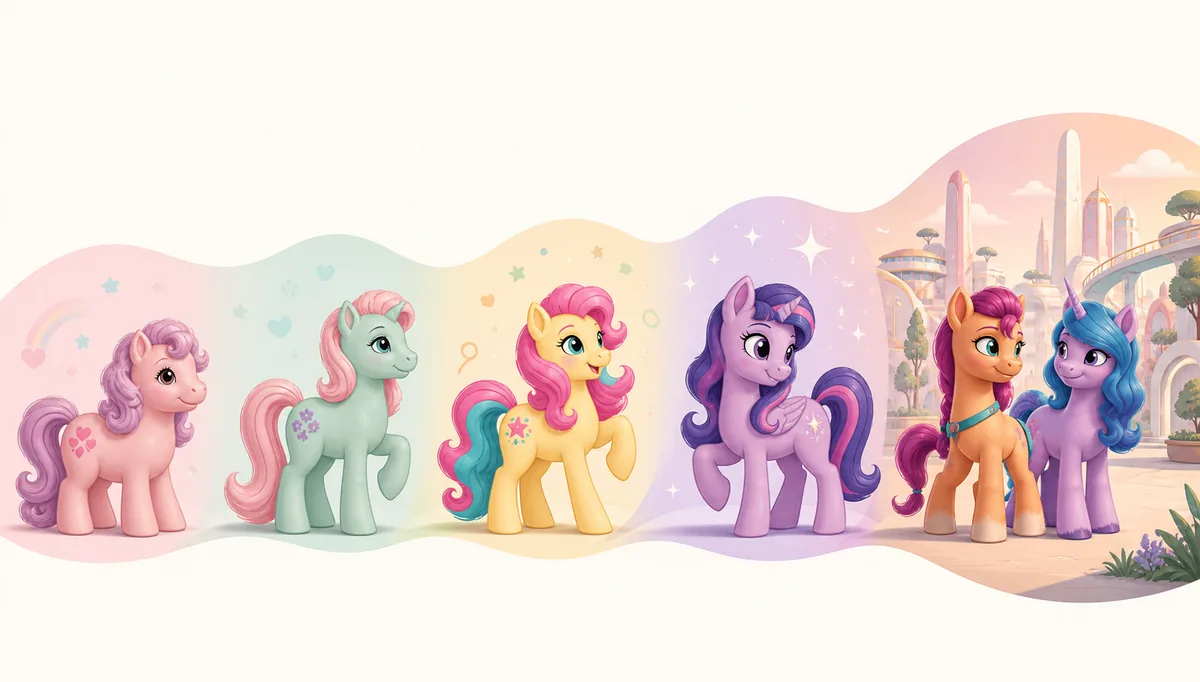
What Counts as a My Little Pony Generation?
A generation is more than a new paint color. It usually describes a coordinated shift in the brand: the proportions and styling of the ponies, the way names and symbols are used, the type of merchandise being sold, and the stories or media used to introduce the cast. A new generation can therefore feel different even when the brand keeps familiar ideas such as friendship, magic, cutie marks, or pony families.
The labels are especially useful when a reader is trying to identify an old toy, search for a specific cartoon, or understand why two fan communities use the same character name in different ways. They are less useful as a strict legal or official taxonomy. Some collectors divide G3 into smaller design phases, while regional releases and special editions can blur the line between one era and the next. That is why a guide to all My Little Pony generations should explain the boundary choices instead of presenting one rigid list as universal.
My Little Pony Generations at a Glance
This overview is designed for orientation. It gives you the fastest way to match a generation label with the kind of media, design, and fan question you are likely to have.
| Generation | Approximate era | What stands out | Best starting point for |
|---|---|---|---|
| G1 | 1980s to mid-1990s | Original pony identity, soft vintage styling, early specials and toy history. | Collectors, nostalgia readers, and fans tracing the brand's roots. |
| G2 | Late 1990s to early 2000s | A shorter transition with sleeker proportions and a more streamlined collectible look. | Readers comparing toy design changes between the original and revival eras. |
| G3 | 2000s | Bright colors, playful poses, large-eyed styling, and pony-focused direct-to-video material. | Fans who remember the 2000s revival or want a colorful pre-G4 entry point. |
| G4 | 2010s | Friendship Is Magic, the Mane 6, Ponyville, detailed character arcs, and a large online fandom. | Most new viewers, character fans, quiz takers, and story-first readers. |
| G5 | 2020s | A New Generation, a contemporary screen identity, new protagonists, and a different visual language. | Viewers starting with newer films or series and readers comparing modern continuity choices. |
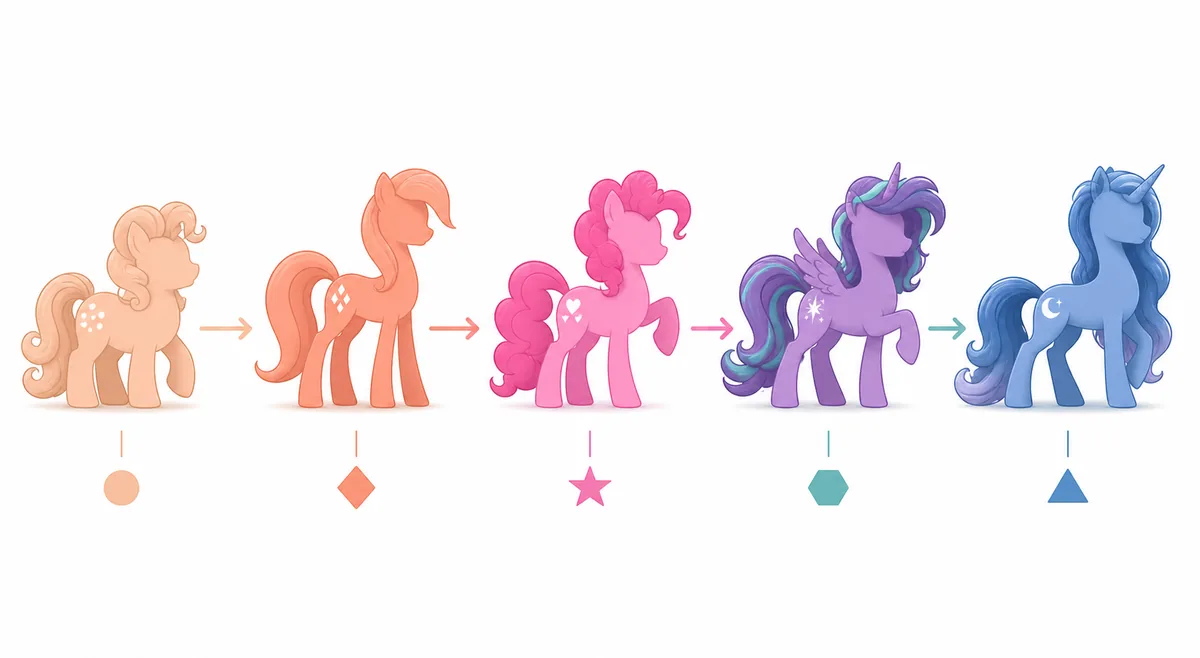
G1: The Original My Little Pony Era
G1 is the foundation for everything that followed. It is the era most associated with the first wave of pastel ponies, long manes and tails, distinctive symbols, and a toy-first brand identity that quickly expanded into animated specials and other media. When a collector says “vintage MLP,” G1 is usually the first place to look.
The G1 world does not map neatly to the modern Mane 6. Names, poses, color combinations, and story roles can feel familiar without being the same characters that later viewers know from Friendship Is Magic. That is why a G1 checklist should record the exact pose, body style, symbol, and release context rather than relying on a name alone. For a focused list of names and collector clues, continue to the MLP G1 characters guide.
Why G1 still matters
G1 gives the brand its visual vocabulary: a pony can be identified through color, hair, symbol, and a small personality cue. It is also the best generation for understanding why collectors care about condition, accessories, factory markings, and regional releases. If you are researching an older toy, photograph the front, side, hooves, and symbol before searching by name.
G2: The Short Transition Era
G2 is often remembered as a bridge between the original vintage identity and the brighter revival that came later. The styling became sleeker and more streamlined, which makes the toys easy to distinguish from many G1 releases even when the color palette still feels recognizably pony-like.
For readers, G2 is less about one universally remembered television story and more about tracking how the product line changed. A generation guide should therefore avoid presenting G2 as a single long-running continuity. It is more accurate to describe it as a transition in design, distribution, and collecting history.
How to recognize a G2 question
Searches that mention slim proportions, European releases, or a late-1990s pony collection often belong in the G2 conversation. If the reader is asking for major cartoon characters or modern quiz results, send them toward G4 or the site's My Little Pony names guide instead of forcing a G2 answer onto a story-focused question.
G3: The Bright Pony-Focused Revival
G3 brought a highly colorful, friendly, and toy-centered revival to the brand. The ponies often have bright color blocking, large expressive eyes, playful poses, and a softer direct-to-video or special-event feel. For many fans, G3 is the childhood bridge between vintage MLP collecting and the story-heavy G4 fandom.
Sub-labels such as G3.5 are useful when a reader is comparing body shapes or a particular product phase, but they should not replace the main G3 explanation on a general guide. Put the broad label first, then use the sub-label only when it changes the identification answer.
What G3 is best for
G3 works well as a nostalgia and design-history topic. It is also a reminder that not every generation needs to be evaluated by the same standard: a toy-focused era can be successful because of color, collectibility, and play pattern even if it does not have the same serialized story structure as G4.
G4: Friendship Is Magic and the Modern Fandom
G4 is the generation most people mean when they search for modern MLP characters, personality traits, Elements of Harmony, or “which pony are you?” It is closely associated with My Little Pony: Friendship Is Magic, the Mane 6, Ponyville, recurring supporting characters, and a story structure that gives the cast memorable strengths, flaws, relationships, and growth.
The generation's strength is the way character identity connects across several layers. A pony has a name, species, cutie mark, personality, friendship role, and story history. That is why G4 supports both character encyclopedias and interactive quizzes. You can explore the site's Elements of Harmony guide for the symbolic layer, or take the Pony Personality Test when you want a playful character match.
Why G4 is the easiest entry point
G4 has the clearest shared reference language for new readers: Mane 6, Ponyville, cutie marks, Elements of Harmony, and recognizable character arcs. It is still worth saying “G4” when you write a guide, because a reader searching for “My Little Pony generations” may otherwise mistake a G4 character explanation for a complete history of the brand.
G5: A New Generation and the Contemporary Screen Era
G5 is commonly associated with My Little Pony: A New Generation and the newer screen and toy identity that followed. It introduces a different group of protagonists, a more contemporary setting, and a visual language that is easier to separate from the hand-drawn look most viewers associate with G4.
G5 is not simply “G4 with new names.” It reuses the wider brand's interest in friendship, magic, and pony communities, but it asks the viewer to learn a new starting map. That makes G5 especially relevant for people arriving from a recent film or series rather than from the original television fandom.
How to read G5 without overclaiming
Use the G5 label to identify the contemporary era, then name the specific film or series when the distinction matters. Do not assume that every character, toy release, or story detail belongs to one perfectly unified timeline. The safest guide separates the generation label from the exact screen entry point.
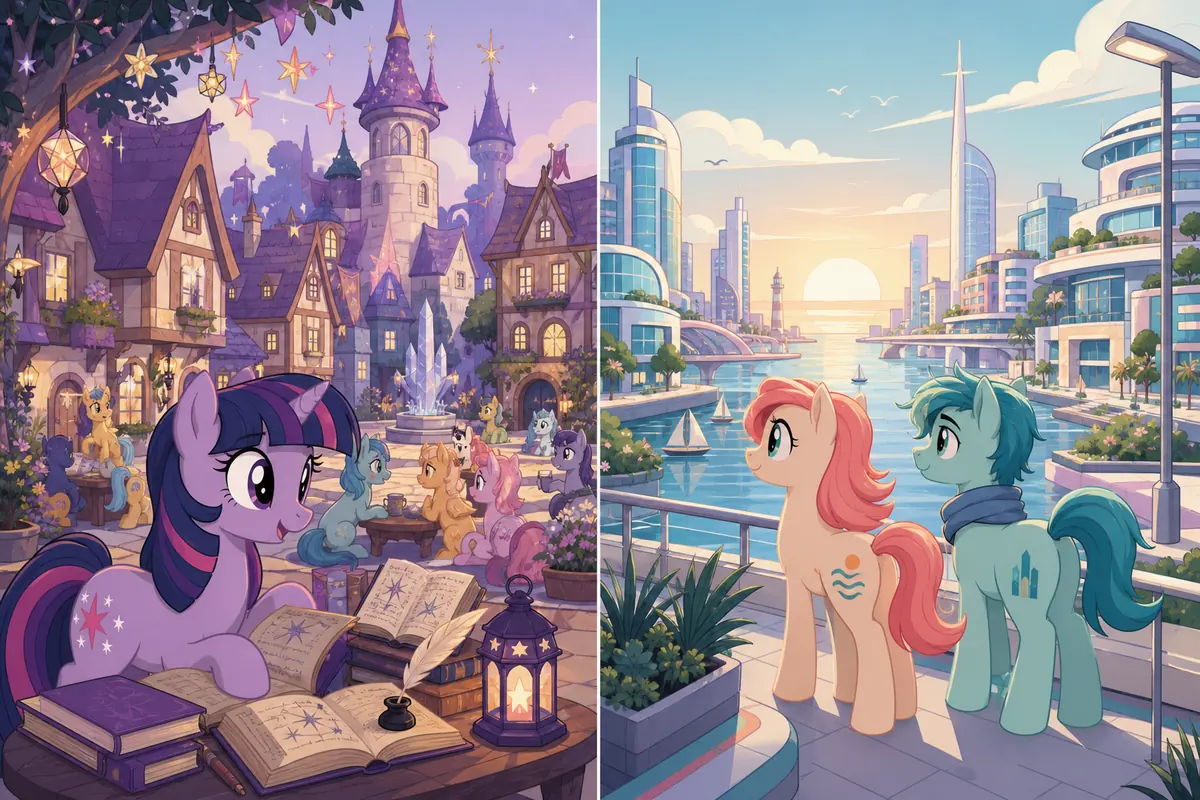
How the My Little Pony Generations Differ
The quickest way to compare generations is to look at four questions: What do the ponies look like? What kind of story introduces them? What does the generation ask fans to collect or remember? What search intent does it create?
| Comparison point | G1–G3 | G4 | G5 |
|---|---|---|---|
| Design language | Changes from soft vintage forms to bright, toy-forward revival styling. | Expressive character silhouettes with strong color, cutie marks, and recognizable personality cues. | Contemporary proportions and screen-ready visuals connected to a newer cast and setting. |
| Primary reader question | What is this older pony, and where does it fit in the release history? | Who is this character, what does the symbol mean, and which pony matches me? | Which newer film or series introduced this character, and how does this world connect to MLP? |
| Best evidence | Toy details, release context, specials, and collector references. | Episodes, character arcs, recurring relationships, and shared fan vocabulary. | Named films, series, character guides, and official announcements for continuity questions. |
| Good site resource | This generation overview and a carefully sourced identification note. | MLP Characters, Elements of Harmony, and the personality test. | This overview plus the specific G5 film or series title the reader is watching. |
Which My Little Pony Generation Should You Start With?
Start with G4 if you want the clearest character relationships, the deepest shared vocabulary, or the easiest path into the site's quizzes and character guides. The MLP character ages guide is a useful companion when you encounter fan claims that mix story clues with exact numbers.
Start with G1 if you care about vintage toy history, original design ideas, or collector terminology. Start with G3 if your strongest memory is colorful 2000s pony media. Start with G5 if you arrived through a newer film or series and want a current-era cast map before reading older fandom references.
There is no requirement to choose one generation forever. Many fans use G1–G5 as a map: G4 for character stories, G1 for origins, G3 for nostalgia, and G5 for a newer visual and screen entry point.
Related MLP Reading
Generations tell you which era you are looking at; these pages answer the next question without competing for the same search intent:
- My Little Pony characters guide for Mane 6 and supporting-character profiles.
- MLP G1 characters guide for original-generation names, groups, and identification steps.
- My Little Pony names guide for character names, naming patterns, and OC name ideas.
- Equestria Girls characters guide for the human-world cast connected to the G4 era.
- MLP Elements of Harmony for the symbolic roles most closely associated with G4.
Sources and Further Reading
For brand context, start with the official My Little Pony website from Hasbro. For a broad historical overview and release-era cross-check, see Wikipedia's My Little Pony overview. Fan-maintained references can help identify regional or collector details, but generation boundaries and sub-labels should be treated as reference conventions rather than a substitute for a specific official release source.
FAQ: My Little Pony Generations
How many generations of My Little Pony are there?
Fans and collectors commonly use five broad labels, G1 through G5. Some eras have sub-labels such as G3.5, and release dates can overlap across markets, so the five-generation map is a practical guide rather than a perfectly rigid official chart.
Is My Little Pony: Friendship Is Magic G4?
Yes. Friendship Is Magic is commonly identified with G4, the generation associated with Ponyville, the Mane 6, detailed friendship stories, and the modern fan vocabulary around Elements of Harmony and cutie marks.
What is the difference between MLP G4 and G5?
G4 is most closely associated with Friendship Is Magic and its established Mane 6 story world. G5 starts from a newer cast and contemporary screen identity through A New Generation and later stories. Both use friendship and magic, but the entry points, visual language, and character map are different.
Are G1, G2, G3, G4, and G5 official names?
They are widely used shorthand in fan and collector communities. The labels are useful for organizing toys and media, but individual releases, countries, and sub-eras do not always fit a single clean boundary. Name the specific toy, film, or series when an exact identification matters.
Is there an official My Little Pony G6?
Search interest around “G6” and “Gen 6” can appear before a stable official generation label exists. This guide does not treat those terms as a confirmed historical generation. For future changes, use an official announcement or first-party release information rather than a fan rumor.
Which generation is best for a new fan?
G4 is usually the easiest starting point for character and story context, while G5 is the natural starting point for someone who arrived through newer screen media. G1 and G3 are better starting points when your interest is vintage collecting or 2000s nostalgia.
Bottom Line
The phrase My Little Pony generations is most useful when it helps you ask a more precise follow-up question. G1–G3 explain the brand's toy and nostalgia history, G4 explains the character-driven fandom many readers know best, and G5 provides a newer screen and design entry point. Treat the labels as a map, then verify the exact toy, film, series, or character when the detail matters.