My Little Pony Species: Earth Pony, Pegasus, Unicorn & Alicorn Guide
The main My Little Pony species are Earth Ponies, Pegasi, Unicorns, and Alicorns. Their silhouettes are easy to recognize, but a useful answer also considers story role, generation, and whether the character is a pony or another creature from Equestria.
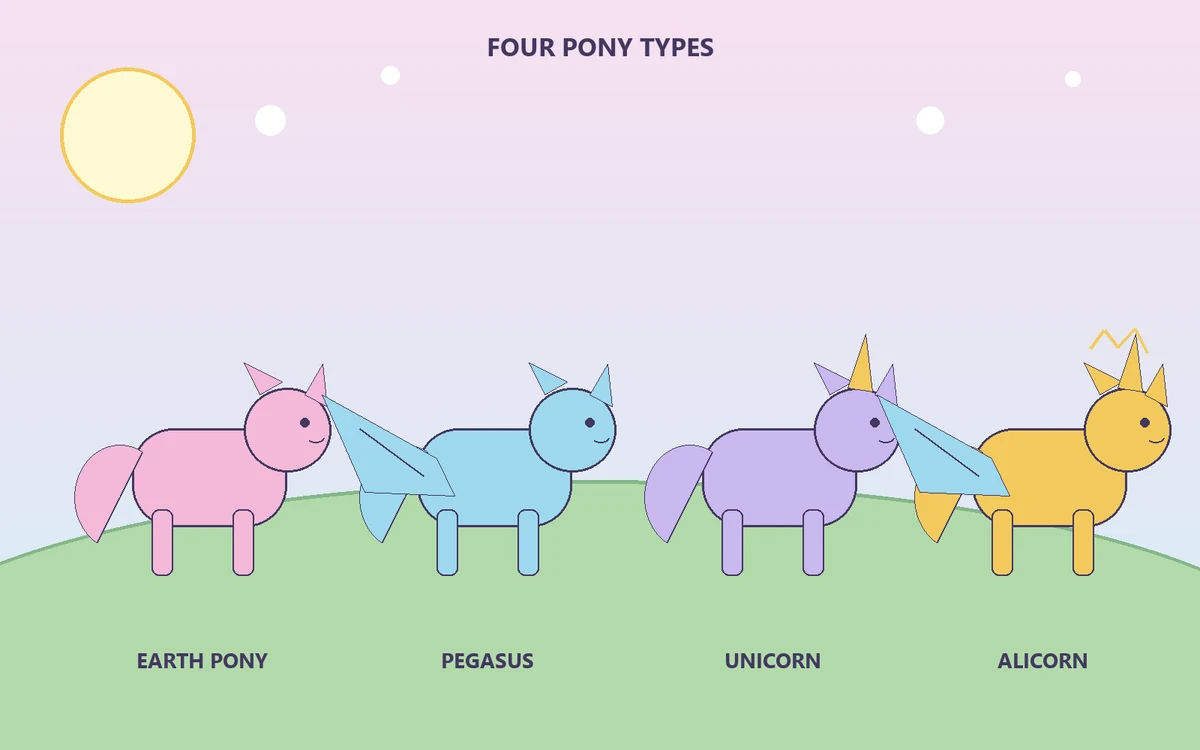
My Little Pony Species at a Glance
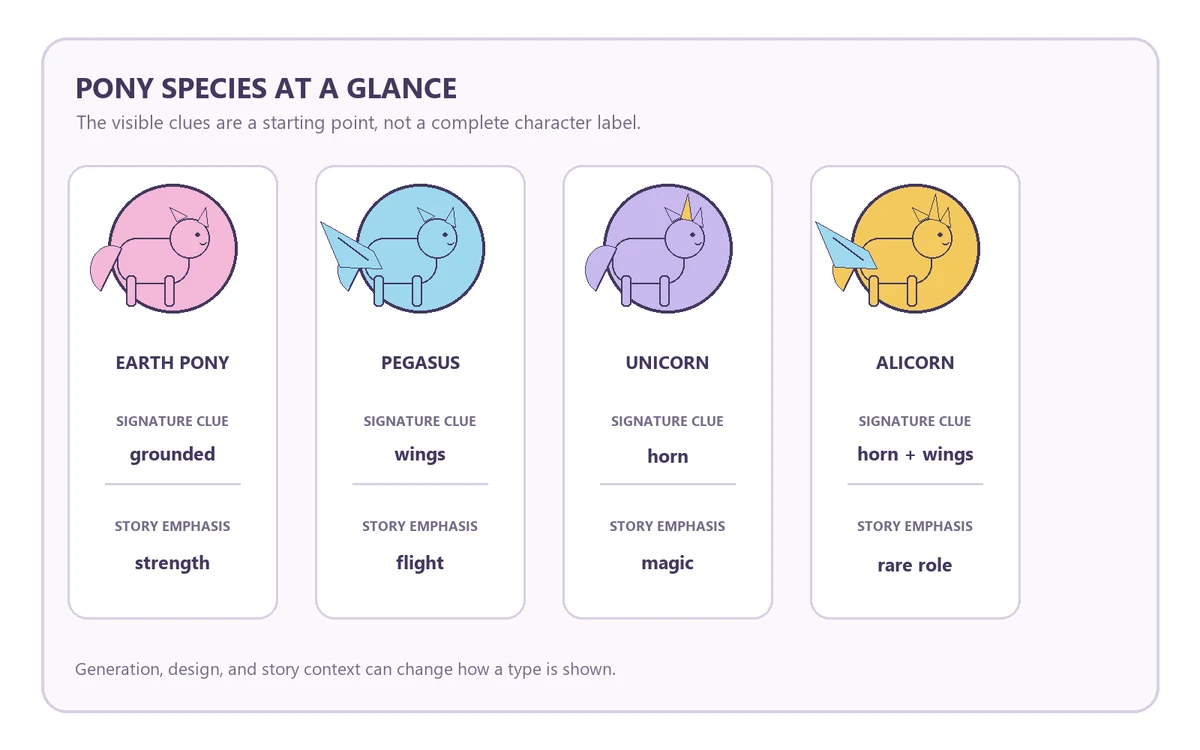
When someone asks for an MLP species list, they usually want the four familiar pony types first. The table below gives the fast answer, while the rest of the article explains why the same type can look or behave differently in another generation.
| Type | Clearest clue | Common story association |
|---|---|---|
| Earth Pony | No horn and no wings | Grounded work, endurance, community, and practical skill |
| Pegasus | Wings | Flight, weather, speed, scouting, and freedom of movement |
| Unicorn | Horn | Magic, study, focus, craft, and spell-based problem solving |
| Alicorn | Horn and wings | Rare power, unusual destiny, leadership, or royal story roles |
These associations are helpful shorthand, not personality rules. An Earth Pony can be an inventor, a Pegasus can be thoughtful and bookish, and a Unicorn can be impulsive. Type describes a character's physical or magical category; it does not decide the whole personality.
Earth Pony: Strength Without a Horn or Wings
Earth Ponies are the easiest baseline in a My Little Pony species comparison: they normally have a familiar pony body without a horn or wings. Their stories often emphasize persistence, physical ability, farming, building, practical knowledge, or a strong relationship with a local community.
That does not mean Earth Ponies are “ordinary” or less magical. Their strengths are often expressed through work, nature, creativity, leadership, or a special connection to the land. Applejack is a clear G4 example, but the type appears in many eras and does not require one specific job or personality.
How to recognize one
- Look for the absence of both a horn and wings.
- Check the generation before applying a modern character profile.
- Use the cutie mark and story role as extra clues, not as the species test itself.
Pegasus: Wings, Flight, and Movement
Pegasi are winged ponies. Flight is their most obvious difference, and many stories use that ability to shape their work: weather duty, aerial rescue, racing, cloud homes, delivery, or fast travel. Rainbow Dash shows the bold competitive version of this type, while other Pegasi can be quiet, anxious, artistic, or highly analytical.
Wings do not automatically make a character a Pegasus in every unusual case. A magical transformation, hybrid design, or generation-specific creature may use wings for another reason. If the character is unfamiliar, combine the silhouette with the name, episode, toy line, or generation.
Unicorn: The Horn as a Magical Tool
Unicorns are ponies with a horn, usually placed at the center of the forehead. In the familiar G4 setting, the horn is associated with spellcasting and a learnable magical skill set. Telekinesis, protective spells, teleportation, and specialized talent can all appear, but the exact limits depend on the story.
Twilight Sparkle is the best-known modern example, yet “Unicorn” is not a synonym for bookish, powerful, or elegant. Rarity connects magic with design and craft, and many background characters show narrower or less dramatic abilities. The horn is the starting clue; personality and talent require separate evidence.
Alicorn: A Rare Combination of Pony Traits
Alicorns combine a horn and wings, which makes them visually easy to identify in an MLP races or species guide. In many fan discussions, they are described as rare winged Unicorn Ponies. Stories also connect individual Alicorns with unusual power, royal duties, transformation, or a major role in the balance of Equestria.
The important caution is that “Alicorn” should not be treated as a simple personality category. A character may become an Alicorn through a story event, and the meaning of that change can be more important than a fixed biological explanation. Compare the character's era and narrative context before making a general rule.
Other MLP Species, Creatures, and Hybrids
The four pony types answer the most common search, but Equestria contains much more than one pony family. Dragons, Griffons, Changelings, Hippogriffs, Kirin, Yaks, and other creatures have their own bodies, cultures, powers, and story roles. Some characters are hybrids or magical exceptions, so a complete list can become very broad very quickly.
This is also where a page can go wrong by treating every creature as an “MLP pony species.” Discord, for example, is a draconequus rather than an Earth Pony, Pegasus, Unicorn, or Alicorn. The site’s Discord MLP guide handles that character-specific question. For the main cast, the MLP Characters guide is the better next step.
How to Identify an MLP Species
If you are looking at a character card, toy, screenshot, or fan design, start with visible anatomy and then add context. This simple process is more reliable than guessing from color or personality alone.
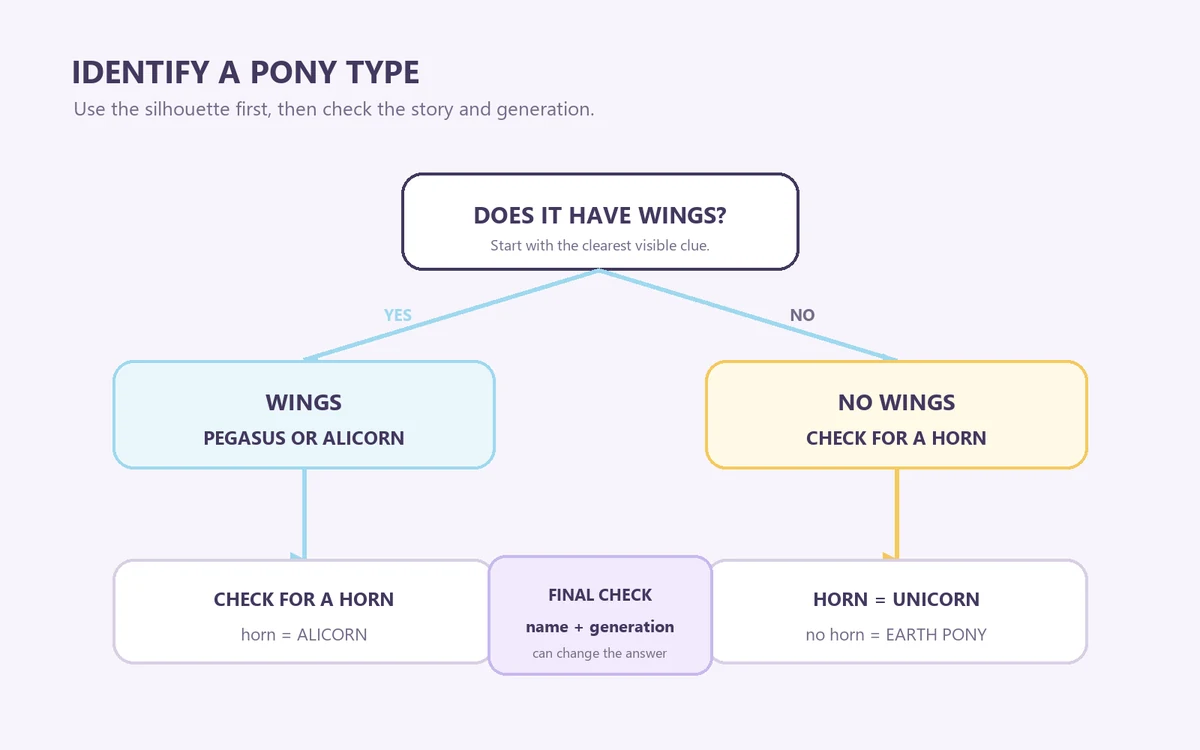
- Check for wings. If the character has wings, the first possibilities are Pegasus or Alicorn.
- Check for a horn. A horn without wings points toward Unicorn; a horn with wings points toward Alicorn.
- Use the no-horn, no-wing baseline. That is usually an Earth Pony, unless the design is a special creature or transformation.
- Confirm the generation. G1, G4, and G5 can use different designs, terms, and world-building.
- Separate type from personality. A character's job, cutie mark, friendships, and temperament are additional layers.
- Record exceptions. Hybrids, magical transformations, and non-pony creatures need a more specific description.
Species, Generation, and Character Are Different
Many “different species in My Little Pony” questions are really three questions blended together. Keeping these labels separate makes the answer clearer:
| Label | What it answers | Example |
|---|---|---|
| Species or pony type | What kind of body or magical category is this? | Pegasus |
| Generation | Which era, design system, and continuity are we discussing? | G4: Friendship Is Magic |
| Character | Which individual has this design and story? | Rainbow Dash |
For an era-by-era overview, read the My Little Pony generations guide. If you are comparing how type affects a quiz result, the MLP Personality Types guide explains the separate personality layer.
What MLP Species Am I?
If you searched what MLP species am I, use the type descriptions as a playful reflection rather than a fixed identity test. Do you feel most at home solving practical problems and caring for a community? Earth Pony may be your symbolic match. Do you value movement and independence? Pegasus may fit. Curiosity and focused craft point toward Unicorn, while a blend of leadership and magical ambition can make Alicorn an appealing fantasy answer.
For a character-based result, take the My Little Pony Test. It answers a different question— which character matches your personality—so it should complement this species guide rather than replace it.
FAQ: My Little Pony Species
What are the main My Little Pony species?
The four familiar pony types are Earth Ponies, Pegasi, Unicorns, and Alicorns. Equestria also includes dragons, Griffons, Changelings, Hippogriffs, Kirin, Yaks, and many other creatures.
What is the difference between a Pegasus and a Unicorn?
A Pegasus has wings and is commonly linked with flight, while a Unicorn has a horn and is commonly linked with magic. Those are starting clues, not complete personality descriptions.
Are Alicorns a separate species?
Fans often call Alicorns a type or species because they combine a horn and wings. The safest fan-guide wording is “rare winged Unicorn Pony,” while recognizing that individual stories may explain their status differently.
Are MLP species the same in every generation?
No. The same broad type can appear in multiple generations with different art direction, powers, social roles, and continuity. Always check the generation before comparing characters.
What MLP species am I?
Choose the type whose symbolic strengths feel most natural: grounded work for Earth Pony, movement for Pegasus, curiosity and magic for Unicorn, or a rare mix of traits for Alicorn. This is a fan interpretation for fun.
Is Discord a pony species?
No. Discord is a draconequus, so his species belongs in a separate creature guide rather than in the four common pony types.
Sources and Related Reading
This is a fan-made, canon-aware guide. For broad brand context, see the official My Little Pony site from Hasbro. For a secondary species overview and terminology cross-check, see the MLP Fandom species category and the Wikipedia overview of the franchise. These links support context; they do not turn a fan interpretation into an official taxonomy.
Continue with My Little Pony Characters, compare eras in My Little Pony Generations, or explore symbols with the MLP Cutie Mark Meanings guide.